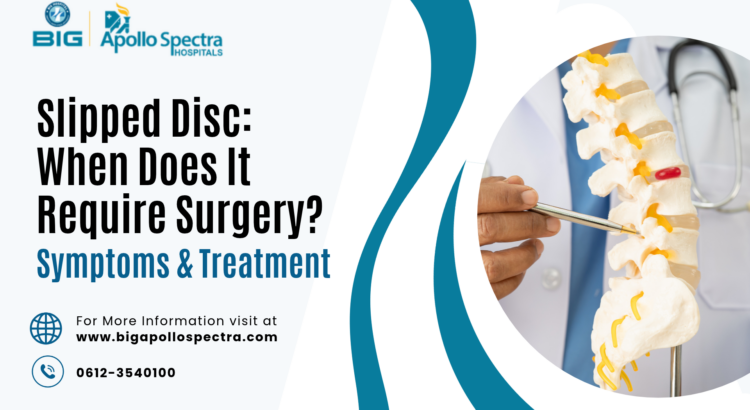
A slipped disc happens when the soft inner part of a spinal disc pushes out through its tougher outer layer. When that happens, it can irritate or press on a nearby nerve.
The result can be back or neck pain, numbness, and trouble with everyday things like walking, lifting or sitting for long stretches. The good news is that not every slipped disc needs surgery. Plenty of cases get better with non-surgical treatment.
Not sure whether your back pain could be related to a slipped disc? Let’s understand the symptoms to watch for, when surgery becomes necessary and what treatment options are available.
Common Symptoms of a Slipped Disc
Symptoms depend on which disc is affected and which nerves it’s pressing on. A slipped disc in the neck (cervical) tends to affect the shoulders and arms, while one in the lower back (lumbar) usually shows up in the buttocks and legs.
Here are the signs people notice most often:
- Persistent lower back or neck pain
- Pain radiating to the arms or legs
- Numbness or tingling sensations
- Muscle weakness in the arms or legs
- Pain that worsens while sitting, bending or coughing
- Difficulty walking or performing routine activities
If these symptoms hang around for more than a few weeks or keep getting worse, don’t just wait it out. See a specialist. Getting assessed early for slip disc treatment in Patna helps pin down what’s causing your pain and whether simple measures are enough.
How Is a Slipped Disc Diagnosed?
At the initial visit, the doctor will listen carefully to the presenting symptoms, get to know the medical background of the patient.
This will be followed up with a thorough physical exam including the check of reflexes, strength, and sensations to locate the injured nerve, as well as the neurological exam.
MRI scan gives the most accurate picture of the herniated disc together with any nerve compression. Additional tests such as x-rays may be performed depending on the situation in the clinic.
Imaging should be taken together with the symptoms and physical findings. MRI findings only suggest a diagnosis, they do not necessitate surgery right away.
>> Book an appointment at Big Apollo Spectra Hospital for expert spine care and accurate diagnosis.
Can a Slipped Disc Be Treated Without Surgery?

A majority of people respond well to nonsurgical measures. Usually, the conservative line of management is recommended first, and many patients will notice improvement with it over time.
Such treatment often comprises pain and anti-inflammatory drugs prescribed by the doctor, physiotherapy exercises and changes of lifestyle that make one avoid aggravating activities.
Regular doctor’s appointments for patients enable one to see whether the prescribed plan is working. On the other hand, self medication and long stay in bed may delay healing.
Treatment is customised according to the degree of the symptom severity and the individual’s response to it.
When Does a Slipped Disc Require Surgery?
Surgery is usually considered only when non surgical care hasn’t been enough. A doctor may bring it up if you have:
- Severe pain that persists despite appropriate treatment
- Muscle weakness that keeps progressing
- Significant nerve compression
- Symptoms that continue to limit daily life
The decision rests on your symptoms, clinical examination and scan results together. If your pain is worsening, a visit to a trusted bone doctor near me search result should lead you to an orthopedic or spine specialist rather than leaving it unchecked.
Surgical Options for Slipped Disc Treatment
Surgeons decide which type of spine surgery is right for you by taking factors such as your general health, where the diseased disc is and how much it is pressing on nerves.
Microdiscectomy
Microdiscectomy is a procedure where the surgeon removes the portion of a herniated disc that’s pressing against a nerve.
The surgeon uses magnification to get a clear view and work carefully around delicate spinal structures, while limiting disruption to the surrounding tissues.
Endoscopic Discectomy
A minimally invasive technique where only a small surgical opening is made, and a thin camera along with special tools go into and out of your back and through the spine and remove the piece of the disk which is crushing the nerves.
This method is probably the one which is done the least but it is a valid approach.
Laminectomy
Laminectomy is a procedure in which the bone forming the posterior part of the spinal canal is taken out to leave more space for the spinal nerves.
The combination of laminectomy with disk surgery may be the way going for the patients in question if there is a need for the decompression of the nerve and the treatment of the intervertebral disc herniation are needed simultaneously.
The best outcome would depend upon a thorough investigation to see which, if any, of your surgical options would yield the best clinical results and improve your condition.
Where to Get Slipped Disc Treatment in Patna?
Big Apollo Spectra Hospital offers specialized orthopedic and spine treatments in Patna, including expert consultations for spinal problems, MRI and X-ray services, physiotherapy as part of conservative treatment options, advanced techniques such as endoscopic procedures, and rehabilitation assistance after treatment.
Dr. Amit Kumar Sinha (M.B.B.S., D.N.B., F.N.B.) is a Consultant Orthopedic Surgeon at Big Apollo Spectra Hospital, specialising in knee and hip replacement surgeries.
Patients seeking slipped disc treatment or joint care can consult the hospital’s orthopedic team, including those looking for a joint replacement surgeon in Patna.
Conclusion
In most cases, a herniated disc isn’t something you’ll need an emergency operation for. If the right non operative methods are carried out, the bulk of patients recover. Operations are typically advised only for specific cases.
It’s up to you to catch the early signs of worsening symptoms, get the diagnosis from a certified professional, and go for the treatment that your condition requires. Big Apollo Spectra Hospital in Patna provides advanced orthopedic and spine care.
If you’ve been experiencing long term back pain or have symptoms of numbness or weakness visit Big Apollo Spectra Hospital and get yourself checked to understand the available treatment options for you.